
The first rule of choosing and using any anchor point is to confirm its suitability for your task or application. This is important because the two broad categories of anchor points – fall arrest and rope access – often look the same and cannot be distinguished easily. However, fall arrest and rope access anchors are not the same. Each anchor type is designed for a different purpose, tested and rated for different types of loads. Even those anchors marketed as dual-purpose should never be assumed interchangeable. In short, you cannot know an anchor’s suitability just by looking at it. Assume nothing, check every anchor point before use.
Fall Arrest Anchors have been designed to arrest your fall
Fall arrest anchor points are designed to do one thing really well – arrest a fall that has already started.

- Fall arrest anchors are engineered to a single-person load rating of 15kN, which is equivalent to ~1,500kg
- They’re designed for dynamic loads and can incorporate deformable sections which yield when activated in order to absorb the shock and energy of a sudden fall.
- This in turn reduces the force impact transferred to both the attached user and the structure supporting the anchor.
- As such, fall arrest anchor points perform a critical role in anchoring your active fall protection system.
- When combined, as they must always be, with an appropriate self-retracting lifeline (inertia reel) or shock-absorbing lanyard and full-body harness, correctly installed fall arrest anchors will successfully arrest your fall.
- Note: Unless specified that the anchor can be used for rope access, a fall arrest anchor is not suitable and should never be used for abseil work.
Connecting to a fall arrest anchor point for fall protection is a height safety requirement when working on an elevated surface that exposes you to an unprotected edge which has a fall risk. As such, fall arrest anchor points are commonly used when performing tasks on residential and commercial rooftops, warehouse loading docks, industrial structures, construction sites, scaffolding and other elevated platforms.
Rope Access Anchors support workers engaged in abseiling
Rope access anchor points are built to sustain the constant load of an abseiling worker.
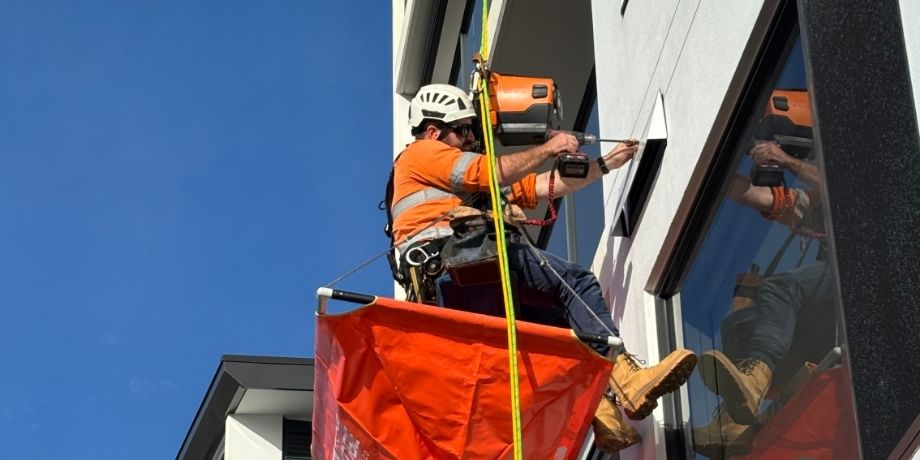
- Rope access anchors may only be rated to a single-person load rating of 12kN, which is equivalent to ~1,200kg. (Note: Safe Work Australia recommend all rope access anchors are install to 15kN)
- They’re built to sustain a constant or static load and are not designed to deform when put under load
- Rope access anchors perform a critical anchoring role in an industrial rope access system, which is a method of enabling work to be carried out on building facades, atriums and other exterior areas via abseiling
- Rope access systems typically rely on two independent rope access anchor points – one to support the worker (main working line); the other to accommodate redundancy (a backup safety line).
- The installation process for each anchor point must consider its purpose and account for the final direction of the load (tensile vs shear) in order to select a suitable rope access anchor.
Rope access anchor points are an absolute necessity for any kind of abseil work. This includes building facade and atrium maintenance, signage and lighting installations, window cleaning, waterblasting and other exterior repairs.
Dual-Purpose Anchors aren’t a one-size-fits-all-tasks solution
Dual-purpose anchors have the potential to support both rope access and fall arrest – however:
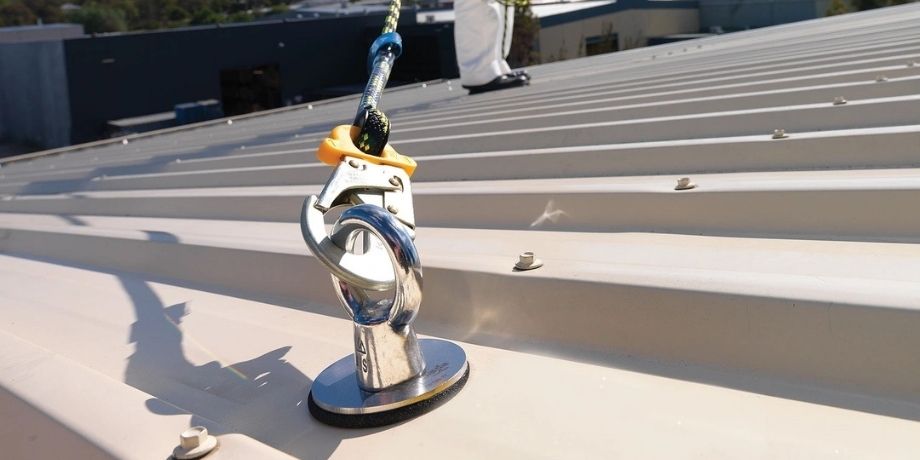
- Any anchor point that is specified for fall-arrest and rope access must have a rating of 15kN dynamic load rating (for fall arrest) and be able to take the static load that a rope access anchor needs.
- The manufacturer’s instructions must confirm that the anchor in question is suitable for both rope access and fall arrest applications.
- The installation report should confirm the anchor in question was installed correctly and without any structural issues which may undermine the suitability of the anchor for either application.
In other words, never assume a dual-purpose marketed anchor is automatically suitable for any task or application you have in mind. Carefully check the documentation of every anchor point before you use it.
Takeaway – Never assume any anchor point will suit your task
- When it comes to anchor points, you can’t judge a book by its cover. The assumption that all anchors are the same is not uncommon, but it is wrong and can be very dangerous.
- There are two main categories of anchors – fall arrest and rope access – both of which are designed and engineered to serve very different purposes.
- It’s important that any anchor you use suits the task or application you’re using it for. You can do this by checking the load-rating of your anchor and reviewing documentation (manufacturer’s instructions and installation report).
- Whilst dual-purpose anchors are available on the market, they require just as much scrutiny (if not more) to determine their suitability.
Not sure about your anchor point? Don’t use it. Call one of our height safety specialists today on (07) 3862 2533. We can talk you through a self-confirmation process and/or book an onsite anchor point inspection at your convenience